Ancient Elvish
The Ballad of the Last DragonAncient Elvish is presented as a language on the edge of disappearance, yet its survival gives Sylvaine Abelan decisive power at a crucial moment in Aeron Fowler’s dragon quest. Written into the directions on an old map beside Common Tongue and dwarven runes, it turns apparently unintelligible marks into usable instructions. The language therefore links a suppressed cultural past to immediate action: what looks dead still possesses the capacity to guide the living.
Definition and Historical Condition
Ancient Elvish is described as a language no longer encountered in ordinary use in Targgein. Even in Smarighad, it had already become a dead language. Its condition is not represented as simple disappearance, however. The language has changed through generations of hiding written words, absorbing elements of Common Tongue, and suffering morphological decay. Its surviving forms are consequently layered, altered, and difficult for outsiders to recognize.
This linguistic fragmentation reflects a history in which written knowledge could not be transmitted openly. Ancient Elvish remains present in damaged or concealed forms rather than as a stable public system. Its obscurity is thus connected to the circumstances of the Elves, whose language and cultural inheritance have been forced into concealment rather than allowed ordinary continuity.
The Dragon Map
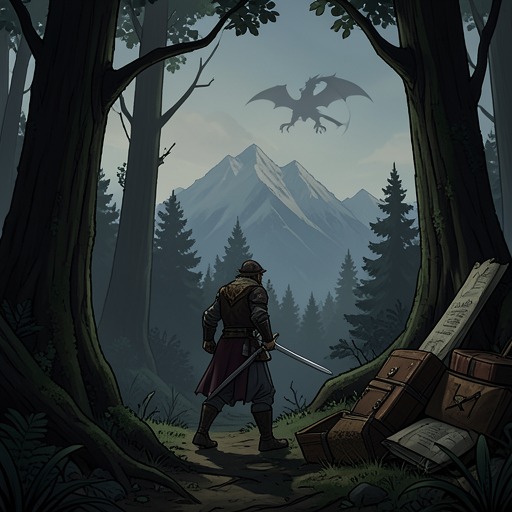
The language becomes materially important when Sylvaine examines Aeron Fowler’s old parchment. The map depicts Targgein with mountains and valleys bearing archaic names, and its marginal directions point toward the dragon’s lair. The instructions combine old Common Tongue, dwarven runes, and Ancient Elvish, making the map deliberately difficult to read rather than merely poorly drawn.
Aeron Fowler initially fears that the unfamiliar words indicate a faulty map. Sylvaine studies the parchment and finds no evidence of trickery or geographical error; the obstacle lies in the mixture of dialects and scripts. She recognizes that the directions are present in full, despite their altered forms, and explains that someone took considerable effort to obscure the map’s meaning. Her knowledge transforms the expedition’s uncertainty into a solvable problem.
Sylvaine then offers to translate the directions. Aeron Fowler responds with open delight, embracing her around the fire before she withdraws from his attention. The scene establishes that Ancient Elvish is not ornamental lore: without Sylvaine’s ability to read it, the company might have been unable to interpret the route to the dragon’s lair.
Sylvaine’s Education and Authority
Sylvaine’s command of Ancient Elvish originates in her childhood household. Her father required her to practice alphabets in the dirt before allowing her to play in the forest. She was expected to master Ancient Elvish, Dwarvish, Common Tongue, and forgotten human languages. For Sylvaine, this demanding education opened access to more stories, making language a gateway to knowledge and narrative inheritance rather than merely a technical skill.
The memory carries a sense of distance: the disciplined child who traced letters in earth seems separated from the traveling performer she has become. Yet the map proves that the learning was not lost. Years later, the forms of the letters remain available to her, and the old practice becomes an expeditionary skill with immediate consequences. Her literacy also counters the assumption that her value lies only in performance. She is a bard, but she is equally a reader, translator, and interpreter of historical traces.
Language, Violence, and Prejudice
The importance of Ancient Elvish gains further force beside the hostility Sylvaine encounters as an Elf. At a tavern, a man calls her a knife-ear and claims that she is fortunate to be allowed inside, ordering her to fetch drinks and invoking what her kind supposedly deserves. Later, Magistrate Ridion dismisses her as an Elf who considers herself more than gutter refuse. These insults attempt to reduce her identity to a despised category and deny her social authority.
Against that degradation, her knowledge of Ancient Elvish offers a concrete form of resistance. The same person whom hostile men treat as servile possesses the specialized understanding required to unlock a map central to the company’s mission. Her linguistic inheritance is both culturally endangered and practically powerful. The contrast exposes the poverty of the prejudice directed at her: those who treat Elven identity as evidence of inferiority fail to recognize the knowledge carried within it.
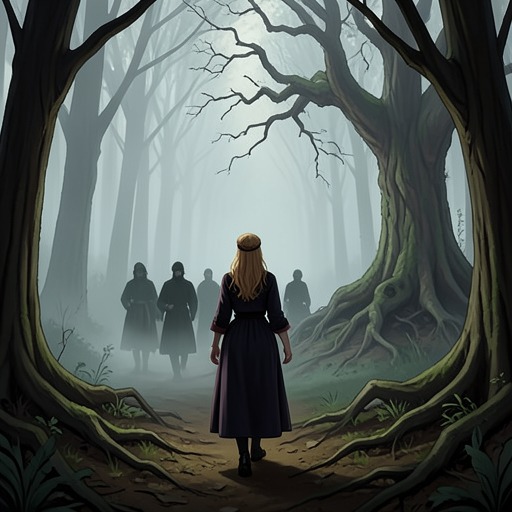
The language’s endangered state also intersects with Sylvaine’s physical vulnerability. When she is alone in a field, she climbs a tree to avoid being seen by three men, carrying her lute, a short sword that Neith insisted she keep, and a shepherd’s sling. During the later assault, her lute is broken and its sharp edges press into her back while her attackers restrain her. These episodes do not directly involve Ancient Elvish, but they clarify the conditions under which Sylvaine’s intellectual resources operate. Her scholarship exists alongside poverty, gendered danger, anti-Elven hostility, and the need for constant self-protection.
Narrative Significance
Ancient Elvish functions as a bridge between loss and survival. It is officially dead or nearly inaccessible, yet it remains legible to someone whose family preserved the discipline to read it. The map’s mixed scripts make the language’s condition visible: cultural memory survives in fragments, altered by concealment, but those fragments can still redirect an entire journey.
The concept also gives Sylvaine a form of authority that cannot be conferred by the people who despise her. Her translation places her at the center of the dragon quest and demonstrates that stories, alphabets, and buried histories can possess material force. Ancient Elvish is therefore both a record of cultural displacement and an instrument of agency. Its apparent ruin does not signify complete erasure; in Sylvaine’s hands, the remnants become directions toward the future.